Quarantine cuisine

Steak au poivre with frites & roasted garlic

Seven years ago, my wife spent her birthday sitting in a room with me, signing a commercial lease on a storefront that would become a bookstore. (And then she sat in a bank, watching me sign paperwork to open up a business account.) It was an exciting day for me but not how she would have chosen to spend it.

Starting a business, especially a brick & mortar one, effectively took me out of the kitchen. I tried to keep up with CSA membership (leadership, even!) but it was not sustainable. The human population of my home had doubled and I was throwing away more wasted, unused vegetables than ever. We tried to split a share with a friend but even that was just too much. My life as an entrepreneur conflicted with my life as an avid home cook.

And so we’ve eaten a lot of takeout. For years. We live in Manhattan, so it’s easy enough to manage, and with good quality and variety (if not the variety of Queens). But I have missed making elaborate meals, keeping chicken carcasses in my freezer for stock, baking pies, getting random ingredients and figuring out how to turn them into meals. I’ve missed feeding us myself.

Isolation has put me back at the stove. We are lucky to live in a pretty affluent neighborhood in Manhattan. Early on in this current era, I had a hard time finding my favorite variety of English muffins [insert world’s tiniest violin gif], and it took two tries before I found rhubarb for tonight’s dessert. But grocery shopping is not a dilemma (for me, at least, as an able bodied person with a healthy bank account). Whether because of the general wealth of this stretch of the E 70s or because there are two full service gourmet markets, two Gristedes, two butchers, one natural foods store, and one weekly greenmarket a very short walk from my home, I haven’t had difficulty finding ingredients.

It did take me a bit to get back into the groove. At first I was cooking tried and true recipes, meals I know my somewhat picky wife likes, just more often. We’ve still treated ourselves to takeout once every week or two. But then there’s the question of supporting local businesses vs making more work for people we really believe should be staying safe in their homes–there are no good choices right now. Honestly I feel the same about the grocery workers. Why should they drag themselves through infected subways to my bougie neighborhood just so I don’t starve? I start thinking about this and eventually get to the endpoint, that the only ethical way to acquire food right now is to grow it yourself. Which is unlikely in my little windowbox. And ultimately we all have to eat. So I’ve been overspending on meat and cheese and bread and racking up hours at the stove and in that small way, I haven’t been this happy in years.

A pitcher of POG juice

Two years ago, we celebrated a milestone birthday + our fifth wedding anniversary (and let’s be honest a delayed honeymoon) with a ridiculous trip to Hawaii. One lasting culinary result of that trip was my wife’s allegiance to POG juice. I ventured 5 whole blocks south yesterday to try the larger branch of our local natural foods store and finally found cartons of passionfruit and guava juice! So my first recipe of the day was just a dump and stir. 2 parts passion, 2 parts guava, 1 part orange. Liquid sunshine.

Flour, butter, water, salt, sugar

Then it was on to pie. I fucking love pie. My wife grew up celebrating her birthday in a more cake-ish fashion, but she knows my strengths probably better than I do so she asked for strawberry rhubarb pie. I swear by Martha Stewart’s pie crust recipe, but her classic Pies & Tarts doesn’t have a strawberry rhubarb. In fact, only one cookbook on my shelf does, the Metropolitan Bakery Cookbook, out of Philadelphia. I’d never made this one before, but by now I trust every recipe in the book. So I plowed ahead, armed with a kitchen scale and a solid grasp of geometry and ratios (my pie plate is 9 1/2″, the recipe calls for 8 1/2″).

Piiiiiiiiiiie

The main course was steak frites with sauce au poivre. We are an omnivore/carnivore household, and lately I’ve been placing orders with Fleisher’s butcher every two or three weeks. Sometimes they are already out of Italian sausage and stew meat when I place my order, so I’ve been learning about cuts of meat! This week I got us a couple of bavette steaks, and we decided to try home made fries.

Pre fries

Nigel Slater was my guide here. But I hadn’t planned ahead as much as I might have, so I only had a litre of olive oil instead of 2. I supplemented with a ramekin of goose fat from the freezer (Christmas still hasn’t ended in our kitchen) and fried those suckers twice. Sprinkled with some sea salt flavored with herbes de Provence, to stick with the French theme.

Pink peppercorns

The sauce for the steak is a modified sauce au poivre, from the Williams-Sonoma cookbook. I couldn’t find green peppercorns but we had a stash of pink ones still. It turned out pretty well, though I’m going to keep an eye out for brined green ones for next time.

Garlic buddies

The last piece was the roasted garlic, another particular request. I got a baguette from Orwashers (curbside pickup FTW) and followed Deborah Madison’s advice: one head per person.

In the end I spent all day in the kitchen, and used five entirely different cookbooks. The dishwasher is running, my wife had a good birthday, and there’s leftover pie for breakfast.

Paella ish

I am, sometimes, back in the kitchen. There is still a lot of work on my plate and we still get a lot of takeout, more than I would like. I am not currently part of a CSA, because I simply could not keep up with that volume of produce. But every once in a while, I get to throw things in a pan and see what happens, and what happens is dinner. That is my favorite version of cooking.

I was at the greenmarket earlier this summer, stopping by after aikido, and bought some chorizo from Flying Pigs. The man who sold it to me asked what I was going to do with it. I said I thought I’d throw it in a pan with the sugar snaps I’d just bought, and some garlic scapes I had in the fridge, and see how it went. He was not impressed with my plan. Granted, he wasn’t invited to dinner, so it’s like I had any reason to try to impress him, but when I saw some gorgeous cherry tomatoes at another stand, things started to take shape.


plated paella

The first step, which feels like step 0, is to put a big pinch of saffron in a bowl of room temperature water. Let it bloom, as they say, while you do the real work of cooking this meal.

Begin with some chorizo. It can be fresh or cured. The cured kind is easier to slice into rounds, but the fresh variety is more tender. You will want to slice it, in any case, into rounds about a finger’s-width thick. Heat some oil in a wide pan and brown the chorizo on both side, then remove to a plate.

Chop up some onion, or garlic scapes, or scallions, and add them to the pan, cooking in the mix of olive oil and pig fat. If you have parsley handy, add in a big handful of that, too.

Next, add in a couple handfuls of rice. If you can find Spanish short grain rice, that is wonderful. If not, arborio or carnaroli is just as good. Any white rice, really, though short grain for preference. Stir it up until the rice is all coated with fat and the onions are starting to cook through.

Slice your cherry tomatoes in half and toss them in, as well. Stir everything up and let hte tomatoes get a little roasted looking with the heat. Pour in the saffron water, making sure that it’s an inch at least deeper than the rice. Make sure to add some salt, at least a half teaspoon. Even with the salt of the chorizo, you need to be sure that the rice is cooked in salted water or it will be inedible.

Turn the heat quite low.

paella in progress

The difference between paella and risotto (one difference), is that you don’t stir now. There is this wonderful crusty bit that forms at the bottom of the pan, called a soccarat, that will start to form even in a non-stick pan. It is the best part, equivalent to the oysters on a chicken.

Get your veggies (sugar snaps are excellent, so are bell peppers. Shell peas would be good, too) ready, by prepping them into bite-sized pieces, or strips, or what have you. Slide the cooked chorizo back into the pan. Then, when the water has cooked off a little, place the veggies around the pan, tucking them in with the rice and meat. The timing there will depend on how crisp you like them. They really only need a blanching, but there is something to be said (by me) for sugar snaps cooked in fat.

When the water has cooked off and the rice is done and the veggies are the way you like them, turn off the heat and serve. If you are lucky, and smart, you will serve yourself the soccarat that has formed.

paella

One day I will write up an actual recipe here, with an ingredient list and everything, but for now it is remarkable that I have time to write this at all.

Bringing the Mountain to Mohammed

It is Labor Day, and I have had really not much of a summer. Admittedly, that was by choice. I started a new business this year–the Astoria Bookshop opened its doors on August 21st!–and it’s the kind of enterprise that doesn’t really allow for picnics in Central Park or weekends spent at the shore. Thankfully, I’ve been too happily busy with work and customers to dwell on my lack of a tan, or the fact that I didn’t swim in the ocean even once this year.

Even so, Connie and I decided that we needed a bit of an end-of-summer feast. So we are having catfish tacos with cabbage slaw, fresh tomatoes, and ricotta salata, with tinto verano and stuffed clams.

These are not just any clams, though. These are Clams Tomasso, my dad’s (superior) rendition of clams casino, one of the first dishes I learned to cook as a child. They are tightly bound up with my conception of summer. Until tonight, I had never made them anywhere except the kitchen at my family’s house at the Jersey shore. But I decided that if I can’t get myself there, then I can bring a little piece of the shore to the Upper East Side.

Start with a bunch of cherrystones. These are usually the largest variety available. Scrub them and stream them open, and hope you didn’t get any duds. Each whole clam makes about one stuffed clam, so think about how many people you’re feeding and that will let you know how many to buy.

image

When they are all open and cool enough to handle, cut out the meat and put it in the food processor. Pulse together with some roughly chopped onion and bell pepper, plus a little garlic, a couple handfuls of breadcrumbs, some olive oil, and any seasonings that seem appropriate (cayenne, old bay, or whatever you like). Our usual ratio is 18 clams to one pepper and one onion, but do it up the way you like it. Just don’t go too heavy on the breadcrumbs or it will taste like a cheap crabcake.

image

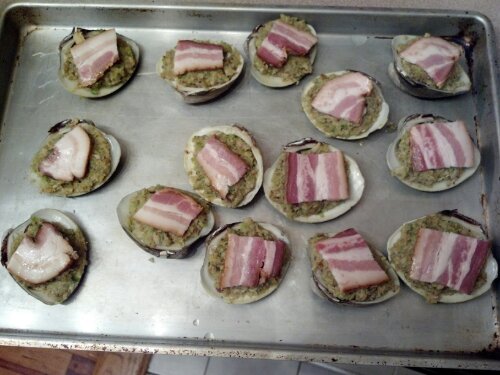
Once everything is to your liking, break the clam shells in half and spoon the mixture into them. You’ll probably only need half of them, depending on how much or little you bulked up the filing. Top each one with a small piece of bacon and bake on a cookie sheet at 350F for 25-30 minutes.

image

Finish under the broiler for another 5. Be sure to let them cool slightly before digging in.

image

These clams are ideally eaten in your neighbor’s front yard while drinking wine from a plastic glass with a fish on it and watching the sunset over the bay. But in a pinch, your couch will do.

Back of the Box

We have been eating a lot of pad thai lately. This is a dish I didn’t even realize you could make at home until pretty recently, when my new friend Z. invited me over, ostensibly to talk about books and Astoria and my nascent business. The evening suddenly became much more delicious, when she and her husband hauled up dinner ingredients to their roof via an external dumbwaiter and made the best pad thai I’d ever eaten, in a wok, on a grill, while watching the sun set over Manhattan. It was truly a memorable evening.

image


According to my calendar, that was last July. A lot has happened since then. I was laid off, my girlfriend moved in with me, we got married, and we signed a lease for our bookstore. We’ve been busting ass to get the store open as quickly as we can, which leaves less time than I would like for my regular kitchen meditation time (aka cooking elaborate dinners). Luckily, the early weeks of CSA deliveries inevitably have a lot of leafy greens that are best eaten in salads or with very brief cooking times. Mizuna, for example, and chinese cabbage.

Another recent news item from our household is that Connie had to have a root canal. The upshot of that is that for a while, at least until she gets a crown on the tooth, she’s got to stick to foods that are easy to chew. Which is how I found myself making pad thai twice in one week.

The recipe, which is derived from the back of the box of Annie Chun’s brand pad thai noodles, is astonishingly easy. Start by putting on a kettle of water. When it boils, pour it over the rice noodles in a big bowl, or a relatively solid tupperware container, and let them soak. While that happens, chop up some shallots or onions, garlic, some tofu or chicken or shrimp, and any asian greens you happen to like. Slice the greens very thin, so they’re only about as wide as the noodles. Then mix up a quarter cup of lemon juice, 3 tablespoons of sugar, 3 tablespoons of fish sauce, and a little crushed red pepper.

Heat up a wok over high heat, and add a little vegetable oil. Dump in the garlic, onion, greens, and whatever protein you’ve chosen. Stir fry them up until the greens are wilted, the onion is translucent, and the meat or fish (if you’re using it) is cooked through. If you’ve timed it right, the noodles will be soft by now. Strain them into a colander and transfer the contents of the wok into the bowl you were using to soak them.

Return the wok to the heat, add another couple of tablespoons of vegetable oil, and crack in two eggs. Scramble them up, and when they’re cooked, pour in the lemon juice/fish sauce combo and add the strained rice noodles. Stir everything together, then add the cooked veggies and a cup of bean sprouts. Turn off the heat and garnish with chopped scallions, crushed peanuts, cilantro or mint, and a squeeze of lime juice.

The result is a wok-ful of sweet/salty/spicy/sour noodles, easy enough to chew for even a patient recovering from dental work. I have a feeling this will stay in the dinner rotation even after Connie’s tooth is back in working order.

In Which I Attempt to Keep Up My Blog While Starting a Business

Stoneledge Farm began our CSA deliveries this week, which means that summer is essentially here. As usual, week 1 was full of leafy greens, and also a helping of rhubarb. It all feels very familiar and comforting.

But something IS different this year: I am in the process of starting a business, the Astoria Bookshop (scheduled to open in mid-August). Which means that I have considerably less time to spend in the kitchen, but also considerably more reason to appreciate the fresh and very cheap produce that I’ve come to love. For the time being, life as an entrepreneur is awfully busy but in a somewhat flexible way. Since the store isn’t yet open for business, I can choose to go to a networking event at a karaoke bar on Friday afternoon, and then spend a Saturday afternoon baking a tart before heading out to look at a table someone is selling on Craigslist.

About that tart: like I said, we got rhubarb this week. We never get very MUCH rhubarb from the farm, but one advantage of being a Core Group member–and also helping clean up at the end of our distribution period–is that you can sometimes snag extras of things that you especially like. So I managed to get enough rhubarb to bake a pie. Then I grabbed a couple of pints of strawberries from one of the produce carts in the neighborhood (their stuff is usually slightly overripe, but/and it’s also incredibly cheap). And then I looked for a solid recipe.

It turns out that strawberry-rhubarb pie is so pedestrian that none of my contemporary cookbooks bother to include a recipe. Luckily, I have a my grandmother’s 70-year-old copy of The Joy of Cooking to fall back on.

I started with my sister’s (not technically) patented instant pie crust recipe, using coconut oil instead of olive oil. It’s stupidly simple–mix flour, salt, a little sugar, oil, and water together with a fork, and press it into a pan with your hands.

Then, two small bundles of rhubarb + 1 pint of strawberries, mixed with sugar, flour, cornstarch, lemon juice, and cinnamon. Pour it in the crust:

image

Bake at 450F for 10 minutes, then at 350F for another half an hour.
image

The lesson of the day is that 4 generous cups of fruit is maybe a little much for a shallow 9″ tart pan. But I was smart enough to put a baking sheet underneath, so the fruit juices that overflowed are not crusted on the bottom of my oven. AND I now have a freshly made strawberry-rhubarb pie to enjoy. Hallelujah! Summer may now begin.

Marigolds

Several months ago, back when the sun was shining for 14 or 15 hours a day and I still had a normal 9-5 day job, I decided that my cookbook shelf was not quite full enough, and I treated myself to a copy of Tender: A cook and his vegetable patch by Nigel Slater. Slater is an icon in the world of British food writing. While I’d heard many wonderful things about him & his cookery books, I’d never actually explored his writing & recipes myself. But I can always use another resource for veggie-centric recipes, especially ones that are not strictly vegetarian (not remotely, in the case of this book). So room was made for this lovely, squat book on my shelf. 

I’ve prepared quite a few of the dishes so far, and one of my favorites was this soup. The header reads “A soup the color of marigolds,” and the recipe is written as a single paragraph. I love this kind of recipe for its simplicity, and for its strict dependence on using the best ingredients. I don’t recommend making it right now (if you live in my region of the world) because you’d be hard pressed to find acceptable tomatoes of any shade, but if you reside in a different climate, or if you can wait until summer comes around again, I highly recommend it.

Start with a shallot, or an onion, or whatever’s handy, and about a pound each of yellow tomatoes* and carrots. Chop them all up, and cook the shallot in olive oil until it’s soft and going translucent.

Img_2421

Add the tomatoes and carrots, and stir them up a bit. Cook for a few more minutes.

Img_2422

Then add a quart of water, a couple of bay leaves, and salt and pepper.

Img_2423

Simmer for a half an hour, until the carrots are quite soft, then puree with the appliance of your choice.

Img_2424

My choice is the stick blender my mom gave me last year, which means I’m no longer in danger of spattering steaming vegetable matter all over myself & the kitchen when I’m too impatient to work in small batches in a regular blender. Feel free to keep the soup kind of chunky, or keep going until it’s velvety smooth–whatever is your preference.

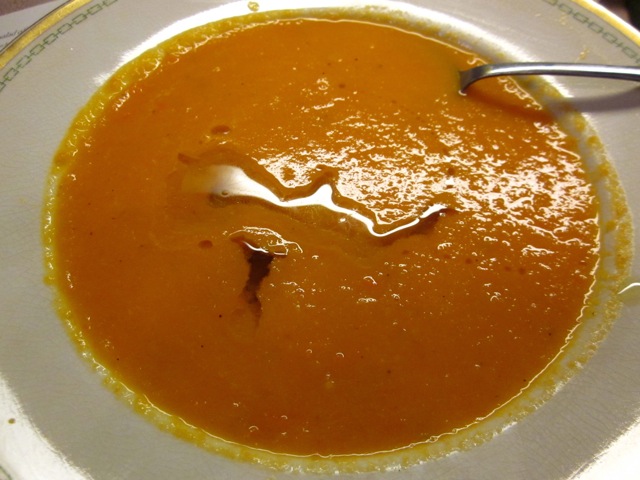
Then just check the seasoning and serve. Slater recommends topping with chopped chives. Having none on hand, I drizzled a spoonful of good olive oil into the bowl.

Img_2425

It is amusing (to me) that some of the most compelling vegetable recipes I’ve found recently are coming from two non-vegetarian British cooks (Slater and Ottolenghi). Historically one equates British food with vegetables boiled into submission, served alongside some meat, or something fried. I like it when people defy expectations.

*You could, of course, substitute red tomatoes. I am not someone who thinks overly hard about presentation, but the color of this soup really is lovely with yellow tomatoes.

Farm Festival 2012

I’m not following through very well on my pledge to keep up with food blogging, am I? 

See the thing is, my day job ended, and a freelance gig began, and a fair amount of bad news arrived, all within a short period of time. If I’d had the presence of mind to think about these things, I would have filled my week with kitchen therapy. Instead, I trudged through, sorted out the complications of the freelancing, and made it to Saturday.

What was so important about Saturday, you might ask? That was the day of the annual Farm Festival at Stoneledge. A few fellow members of the Jan Hus CSA and I hitched a ride on a bus with the Chelsea CSA and went up to the farm. The weather was threatening, the wind was gusting, and the bus driver was shouting in Russian on the phone the entire drive, but when we got to the farm, a beautiful thing awaited us: two pigs, roasting on spits, courtesy of the couple who runs Paradis to Go, a wonderful little restaurant just south of Union Square. 

Img_2351


The pork wasn’t quite ready, and it was still pretty early, so we took a hayride through the fields before lunch.

Img_2353


Img_2357


We drove by rows of cauliflower, sitting by themselves amidst land that has already been harvested. 

Img_2362


We saw many varities of kale. 

Img_2363


For color, my favorite is lacinato (aka dinosaur) kale. It’s almost blue against the bright green of its neighbors.

Img_2365


At the far end of the farm is a field of flowers, which we were invited to pick from later.

Img_2367


In a nearby barn live rooster & 2 hens, who were not cooperating in my attempts to photograph them.

Img_2368

One section of the barn was filled with garlic, hanging up to dry & cure. Pete told us it would be ready to distribute in a couple of weeks. We love garlic, and we smiled & nodded, but mostly D. and I were squealing with delight, looking at the crop we helped to plant last fall, when we came up for a work day after the hurricane.

Img_2370

Img_2374


Winter squash was in the barn next door.

Img_2376

I was drawn to a bright burst of purple in the midst of all the broccoli. The broccoli crop has been fantastic this year (much to C.’s dismay), and the air in the fields was redolent of the stuff.

Img_2380

Upon our return from the hayride, lunch was just about ready. Each member was also asked to bring a dish to share (I made broccoli & roasted pepper salad with tomato vinaigrette), so we ended up with a really wonderful potluck, supplemented with pork & grilled corn on the cob.

Img_2383

Aside from a brief shower, and some VERY strong gusts of wind that overturned one or two of the potluck dishes, the weather was perfect. We even got a little sun.

Img_2384

After lunch, we went back into the fields, on foot this time. We picked some carrots, a task at which I do not excel. We snacked on a few of the last cherry tomatoes, and walked by the late peppers.

Img_2385

This parsley seemed to know that autumn is coming, changing colors in solidarity.

Img_2388

I have kind of a thing for sunflowers, and I was just as happy to get a few good pictures of them as I was to pick a few to bring home.

Img_2389

I picked more than a few zinnias, though. We’ve got three vases full of flowers in the apartment now, and I could not be happier.

It’s a lot of work for the farm to prepare for the festival each year, and it takes hours and hours out of their already intense work schedule. There was packing and sorting going on even while the members were sitting & eating & gabbing, taking hayrides, buying locally produced goat cheese. We assured the farmer that if things weren’t counted out exactly right for our Monday delivery, we would understand. We were just so glad to be up at the farm, getting to know the land, and enjoying a sense of place. 

When I start talking to people about belonging to a CSA, I think I sometimes sound a little bit loopy. I understand that from a certain perspective, they are just vegetables, and one can buy vegetables anywhere. But being a member, and especially playing a role in the continuation of our group this year, has made me even more passionate about the ideals behind the “eat local” trend. I love knowing where my food comes from, knowing the people who plant it & grow it & harvest it. It is a gift to have the opportunity to talk to them in person about their work & their strategies for dealing with the realities of farming. Visiting the farm was a reminder of how happy it makes me to be a part of this community. And as an aspiring small business owner, I hope that I will be as lucky to find a community that supports my endeavor just as fervently.

A Taste of New Orleans

C. and I are both quite fond of okra, but we don’t always know what to do with it. The flavor is purely vegetal, and you have no doubt that you’re Eating Plants, as Mr. Pollan advises us to do. But the texture goes so quickly from crunchy to chewy to mush that I am reluctant to experiment too much with this particular plant. That, thankfully, is what cookbooks and food blogs are for. I love the Ottolenghi recipe I’ve made before (which also works with green beans), and I was very pleased with my rendition of gumbo (though it is not much like C.’s favorite version, from Big Mamou’s in Springfield, MA). Okra can be very good fried, but I hate deep-frying anything in my own kitchen. 

So this week, I happened to remember one of the cookbooks I acquired while working for a publisher, Beyond Gumbo: Creole Fusion Food from the Atlantic Rim by Jessica B. Harris. Naturally, it’s got a half dozen or so options for dishes using okra. Creole Okra seemed like it would work very well over cheesy grits (Deborah Madison’s double-boiler version), and so that’s what we had for dinner.

Start with onion, or leeks if that’s what’s in your fridge. Saute them in olive oil until translucent.

Img_2339

Add minced celery, bell pepper, a hot pepper if you like, and a bit of tomato paste. Cook for five minutes.

Img_2340

Add chopped tomatoes and a few dashes of Tabasco sauce, and cook some more until things sort of thicken up. Theoretically, the tomatoes should be peeled & seeded, but those are tedious steps to take, so I didn’t bother.

Img_2341

Add the trimmed okra and cook, partially covered, for about 10 minutes, until the okra is just tender. 

Img_2342

The author suggests serving over white rice, which would surely be wonderful. Admittedly, I am a rice fanatic, so I always think that’s a wonderful idea. It was very good with the cheesy grits, too.

Img_2344

Creole Okra over Cheesy Grits
adapted from Jessica B. Harris
serves 4-5

3-4 leeks, cleaned & chopped coarsely
1 Tbsp olive oil
1 small stalk of celery, minced
1/3 c red bell pepper, minced
1 jalapeno pepper, seeded & minced
2 tsp tomato paste
2 large tomatoes, coarsley chopped
Tabasco to taste
3/4 lb fresh okra, trimmed
Cheesy grits for serving, from your favorite recipe, or white rice

Saute the leeks in the olive oil over medium heat until translucent. 
Add the celery, bell pepper, jalapeno, and tomato paste. Cook another 5 minutes. 
Add the chopped tomatoes & Tabasco, and continue cooking until the sauce thickens.
Add the okra. Cook another 10 minutes, partially covered, until the okra is tender.
Serve over grits or rice.

What’s in the Box – week 12

Img_2338

Tomatoes-2 pounds

Cluster Tomatoes-1 basket
Broccoli-1 head
Summer Squash-1 pound
Summer Savory-1 bunch
Onions-2
Peppers-3
Spinach-1 bunch
Carrots-1 bunch
Okra-take it if you like

1 bag each of 
Plums
Peaches
Nectarines

I am quite delayed in doing the tally this week, but I think I have a pretty good excuse for that. I have a lot going on at the moment, finishing up a dayjob & getting going with a very big new project. I’m hoping that my food blogging will not get tossed out the window completely in the coming months, but it will probably take something of a back seat. Cooking is therapeutic for me in a lot of ways, from the calming effect of spending time in the kitchen, to the end result of eating better than I would if I relied on take-out, and the compulsory socializing when I cook for other people. So I will definitley still be cooking, but the record-keeping will likely slow down.

But back to this week: 

The tomatoes are evidently past their peak, which means we only (only!) got TWO pounds this week, plus the cluster tomatoes, which are sort of like giant cherry tomatoes. I never worry about using up tomatoes, especially once I established the strategy of taking at least a few that are underripe. They redden sitting in the windowsill with no problem.

I took the broccoli, even though C. hates it with a fiery passion, because I like it, and because all that was in the swap box was summer savory, and I’m pretty well stocked on that at this point. But that doesn’t mean I have a plan for it.

The okra went into a Creole recipe along with one of the peppers, served atop cheesy grits. Post tk on that. It was quite good.

I think I will finally make zucchini bread this weekend. 

The spinach and the cluster tomatoes might go into this unorthodox mac & cheese recipe I’m testing for a cookbook (not mine), though technically I’m supposed to use baby spinach.

Meanwhile we still have a few peaches & things left from last week, so I will definitely have to make a dessert of sorts to hack away at that pile. Or possibly a shrub.

Bucatini in Ragu di Salsiccia

This is a post that starts with a book, which is only right given my real news of the week. 

The Geometry of Pasta is a book I had coveted for quite a while, and even put on my Christmas wish list one year. But nobody took the bait until the following year, when C. gave it to me, because she loves me and because she knows what kind of dinners would result. The idea behind the book, and behind a lot of Italian cooking, is that certain shapes of pasta belong with certain specific sauces for very important, math-based reasons. Orecchiette, for example, go wonderfully with crumbled sausage and chopped broccoli rabe, because the bits of meat and vegetables nestle into the ear-shaped pasta. Some sauces cling better to a pasta with ridges. Some pastas work best with rich, oily sauces. In short, the reason Italian menus so often look the same is that there is a Right Way of Doing Things. The Italians might not be as rigid in their culinary techniques as the French, but there is still quite a lot of thought behind all those traditional recipes. And this book explains the process.

I appreciate when there is a Right Way of Doing Things in the kitchen, but as often as not, knowing the Right Way just provides me with the ammunition to do things My Way and still get a good dinner out of it. Which is what happened here. I had a box of bucatini, and a pile of tomatoes, and some sausage. Bucatini, I learned, is traditionally served with an amatriciana sauce, but all the other ones on the approved list were equally rich, even if they weren’t meat-based, and often had a base of tomatoes. So I flipped around, found a recipe intended for gnocchi, and voila*, bucatini with sausage ragu. 

Begin with some sausage links. Brown them in oil, in a hot pan, and then remove to a plate. It’s ok if they haven’t cooked through, because they will later. Slice them into 3/4″ rounds and then move on to the veggies. 

Chop the garlic, and brown it just slightly in olive oil. 

Img_2291

Then add some red pepper flakes, a lot of chopped tomatoes, and the sausage chunks.

Img_2292

Simmer for a long time, like nearly an hour. Don’t wait as long as you think you should to get the pasta water boiling, because bucatini, man, even with the hole down the middle, they take a rather long time to cook through. Which should be done in nicely salted water. Save a cup of the pasta water, just in case the sauce needs thinning, then drain the pasta.

Take the sauce off the heat and add in some fresh herbs, The cookbook recommends rosemary, but I had an abundance of basil, so that’s what I used, and it was lovely.

Img_2293

Taste for salt (which shouldn’t be a problem, given all that sausage) and mix in the pasta. 

Img_2294

I highly recommend this slightly unorthodox pasta/sauce combination. I also recommend having it for leftovers the next day, with or without some added fresh chopped tomatoes. If you opt for the tomatoes, try drizzling on a little red wine vinegar and olive oil.

*What is Italian for “voila”?